Webb and Hubble Capture the DART Asteroid Impact
Infrared and optical views of humanity's first kinetic asteroid deflection test.
Learning terms
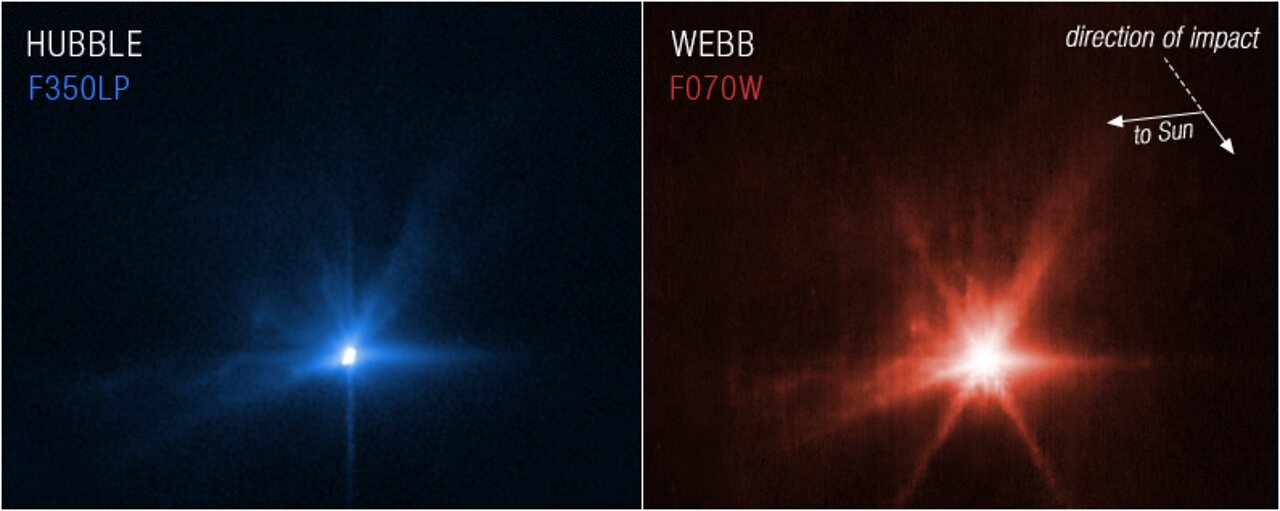
Version 1 · Expansion-batch seed: DART asteroid impact.
What happened
ESA/Webb reported that Webb and Hubble captured detailed views of the DART impact. DART hit Dimorphos at high speed, excavating a plume of debris and altering the moonlet's orbital period around Didymos — the key success metric for planetary defense.
Webb's infrared observations complemented Hubble's optical imaging by tracing dust thermal emission and debris evolution in bands sensitive to particle properties.
On 26 September 2022, NASA's DART spacecraft collided with asteroid moon Dimorphos; Webb and Hubble captured ejecta (weic2215) from the first kinetic deflection test.
Ejecta streams from Dimorphos were tracked in the hours and days after the 26 September 2022 impact.
Why it matters
Near-Earth asteroids are a measurable hazard class. Kinetic impactors are one mitigation concept. DART moved the problem from simulation-only into empirical engineering astrophysics. For Cosmic Gateway, the story is also methodological: solar-system astronomy, spacecraft operations, and infrared debris physics meet in one event.
The experiment moved planetary defense from simulation to measurement: orbital period change plus debris documented across wavelengths including infrared astronomy.
Binary orbit timing provided a clear dynamical metric for this asteroid deflection experiment.
How it was measured
Ground-based telescopes timed Dimorphos's mutual orbit eclipses/brightness variations to measure the period change. Webb and Hubble imaged ejecta morphology and brightness over time. Infrared photometry constrains dust; optical imaging constrains scattered-light morphology. LICIACube (ASI) provided close flyby context separately from Webb/Hubble.
Webb infrared and Hubble optical imaging tracked ejecta evolution; ground-based timing measured the Didymos–Dimorphos orbital period change after impact.
Webb thermal infrared sensitivity complemented Hubble optical scattering in weic2215 plume studies.
What scientists thought before
Kinetic-impact asteroid deflection had been modeled extensively and tested in laboratory analogs, but never demonstrated end-to-end on a real binary asteroid with a measurable orbital-period change. Didymos–Dimorphos was chosen because the secondary's orbit provides a dynamical clock visible from Earth. Great observatories were expected to document ejecta, while mission teams measured the period shift. The prior state was strong theory and engineering design; DART converted that into a confirmed space experiment.
What remains uncertain
The momentum enhancement factor depends on ejecta launched backward from the impact. Subsurface structure of Dimorphos was unknown a priori. Treat weic2215 as an official multi-observatory release documenting the astronomical imaging, while mission papers carry the orbital-period and beta results. Planetary defense sits at the boundary of astronomy and engineering. DART's success metric was dynamical: change Dimorphos's orbital period by a measurable amount. Plume images are scientifically rich and publicly compelling, but they are not themselves the deflection proof. Cosmic Gateway keeps that hierarchy clear so aesthetics do not outrank the clock.
Infrared observations constrain dust properties in the ejecta, complementing Hubble's optical scattered-light views. Together they document how impact energy couples into debris. The momentum enhancement factor beta then folds ejecta physics into deflection efficiency — a number future missions will need for other targets.
Confirmed status here means the impact happened and the orbit changed as mission analyses reported. It does not mean every asteroid will respond like Dimorphos. Material strength, porosity, and shape are variables. Official ESA/Webb release weic2215 anchors the great-observatory imaging chapter of that larger experimental story.
Binary asteroids offer a built-in clock: the secondary's orbital period can be timed with light curves from Earth. That is why Didymos–Dimorphos was chosen. Mission design and astronomy measurement strategy were inseparable.
Public communication should state both results: ejecta were observed, and the orbit changed. Omitting either half mis-teaches planetary defense.
Momentum enhancement depends on ejecta physics; Dimorphos response does not automatically generalize to all asteroid types and rubble piles.
Long-term orbital evolution of the Didymos system after ejecta recoil remains monitored.
Follow-up monitoring continues to constrain how ejecta evolution affects the binary system long-term.
Key sections
- What happened
- Webb and Hubble imaged the aftermath of NASA's DART kinetic impact on Dimorphos, capturing ejecta from the first asteroid deflection test.
- Why it matters
- It demonstrated that a spacecraft impact can change an asteroid moon's orbit — a foundational planetary-defense experiment.
- How it was measured
- Infrared and optical imaging tracked ejecta; ground-based timing of the Didymos–Dimorphos orbit measured the period change.
- Prior understanding
- Kinetic impact deflection was modeled extensively; DART provided the first full-scale space demonstration on a real binary asteroid.
- What remains uncertain
- Ejecta mass, momentum enhancement, and how other asteroid types would respond remain actively modeled.
Build understanding
- Asteroid
A rocky body orbiting the Sun, leftover from solar-system formation.
- Infrared astronomy
Observing the universe in infrared light to see cool dust, embedded stars, and redshifted galaxies.
Related discoveries
Continue through nearby stories that share instruments, objects, or ideas.
- Webb's Close-Up of Neptune and Its Rings
Infrared imaging sharpens Neptune's rings, moons, and storm-world atmosphere.
Nearby solar-system targets observed across missions.
Sources
Primary sources first. News tips are secondary signals, not the canonical account.
- Webb and Hubble Capture Detailed Views of DART Impact
Primary · official release · ESA / Webb