K2-18b: Intriguing Atmospheric Signals, Unsettled Claims
Webb spectra of a sub-Neptune spark debate — especially around possible biosignature interpretations.
Learning terms
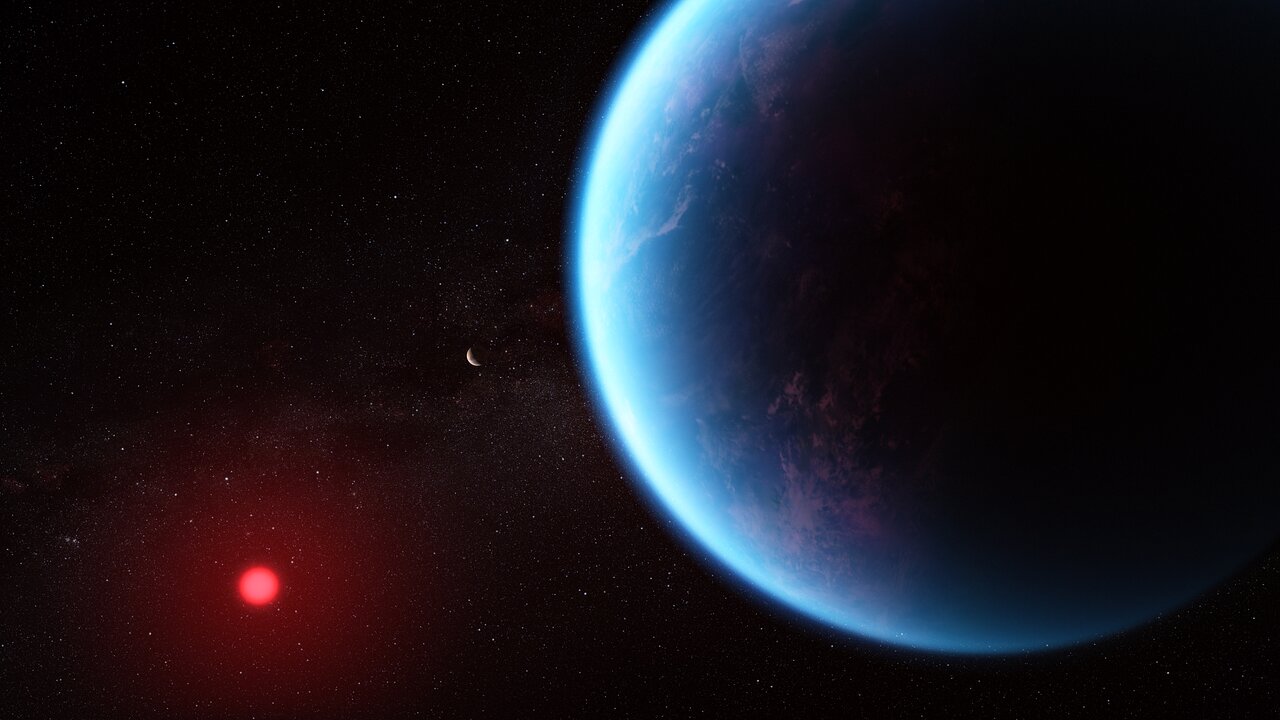
Version 1 · Launch-batch seed: K2-18b atmosphere signals (preliminary).
What happened
In September 2023, a research team using Webb's NIRISS and NIRSpec instruments reported detecting methane and carbon dioxide in the atmosphere of K2-18b, an exoplanet about 8.6 times Earth's mass orbiting a red dwarf star roughly 120 light-years away. K2-18b sits within its star's habitable zone, the orbital distance range where a planet could in principle support liquid water on a surface, if it has one.
The same analysis reported a low-confidence, tentative signal consistent with dimethyl sulfide (DMS), a molecule produced on Earth primarily by marine organisms. The official ESA/Webb release (weic2321) and the associated research explicitly described the DMS hint as preliminary, at low statistical significance, and requiring confirmation.
Why it matters
K2-18b sits at the center of the "hycean world" hypothesis — the idea that some sub-Neptune-sized planets might host deep oceans beneath hydrogen-rich atmospheres, potentially compatible with life as a theoretical possibility. That hypothesis makes any hint of a biologically associated molecule here newsworthy, and also makes careful, cautious language essential.
For learners, K2-18b is one of the clearest cases in this era of exoplanet science where the gap between "detected molecule" and "evidence of life" must be held firmly. Methane and carbon dioxide are well-confirmed and scientifically valuable on their own, telling researchers about atmospheric chemistry; the DMS hint is a separate, much weaker claim that does not currently meet the bar for a biosignature detection.
Linking the exoplanet and transit-spectroscopy concepts here supports that caution: the same method that reliably detects methane can also produce marginal, statistically fragile signals for other molecules, and distinguishing the two requires understanding how transit spectroscopy actually works, not just reading a headline.
How it was measured
Transit spectroscopy captures starlight passing through K2-18b's atmosphere during transits, with the resulting spectrum revealing absorption features from specific molecules. NIRISS and NIRSpec together provided wavelength coverage sufficient to identify methane and carbon dioxide features with reasonable confidence.
The tentative dimethyl sulfide signal, by contrast, sits near the edge of what the data can currently distinguish from noise or from other molecules with overlapping spectral features. Confirming or ruling it out convincingly will likely require additional observations, potentially using Webb's MIRI instrument to access different wavelengths, along with independent analysis from other research groups.
What scientists thought before
Before this result, K2-18b was already known as a sub-Neptune in its star's habitable zone, and prior Hubble observations had detected water vapor in its atmosphere, though later reanalyses debated whether that signal might instead be methane. The hycean world concept itself, proposed by researchers studying planets like K2-18b, predates this specific Webb detection.
The scientific community's prior stance was cautious optimism about hycean worlds as a category, paired with skepticism about any specific biosignature claim without strong, independently confirmed evidence. This Webb result updates the atmospheric composition picture for K2-18b specifically while leaving that broader cautious stance intact.
What remains uncertain
Multiple independent research groups have publicly questioned the statistical robustness of the dimethyl sulfide signal, and follow-up observations to test it more rigorously are an active priority for the field; no consensus interpretation currently supports treating it as confirmed, let alone as evidence of life.
If a headline about K2-18b ever claims "signs of life," treat that as a red flag rather than an update on the actual science. From here, the exoplanet and transit-spectroscopy concept pages explain the method well enough to see exactly why this particular signal needs more data before it means anything definitive.
That distinction is the single most important thing to carry away from any K2-18b headline: a well-supported molecule is not the same thing as a confirmed biosignature, and a confirmed biosignature would still not be the same thing as confirmed life.
Key sections
- What happened
- Webb transit spectroscopy of K2-18b indicated atmospheric methane and carbon dioxide, with more speculative features debated in follow-up discussion.
- Why it matters
- It shows Webb can probe temperate sub-Neptune atmospheres — and that biosignature-style claims need extraordinary caution.
- How it was measured
- Infrared transit spectra and atmospheric retrievals measure molecular absorption; weak features are especially model-sensitive.
- Prior understanding
- K2-18b was a known temperate-zone sub-Neptune; Hubble-era work already suggested a hydrogen-rich atmosphere with possible water vapor.
- What remains uncertain
- Biosignature-related interpretations remain unproven; alternative chemistry and noise can explain weak spectral hints.
Build understanding
- Exoplanet
A planet that orbits a star other than the Sun.
- Transit spectroscopy
Measuring a planet's atmosphere by watching starlight filter through it during a transit.
Related lesson
- How Transit Spectra Reveal Atmospheres
Learn why a tiny dip in starlight during transit can expose molecules in an exoplanet's air.
Related discoveries
Continue through nearby stories that share instruments, objects, or ideas.
- Webb Reveals WASP-39b's Atmosphere in Unprecedented Detail
Transit spectroscopy detects carbon dioxide and a rich inventory of gases in a hot exoplanet.
Transit spectroscopy: clear chemistry vs unsettled claims.
Sources
Primary sources first. News tips are secondary signals, not the canonical account.
- Webb discovers methane and carbon dioxide in K2-18 b
Primary · official release · ESA / Webb