Webb's Portrait of Stephan's Quintet
A compact galaxy group becomes a laboratory for mergers, shocks, and black-hole feedback.
Learning terms
Version 1 · Expansion-batch seed: Stephan's Quintet interactions.
What happened
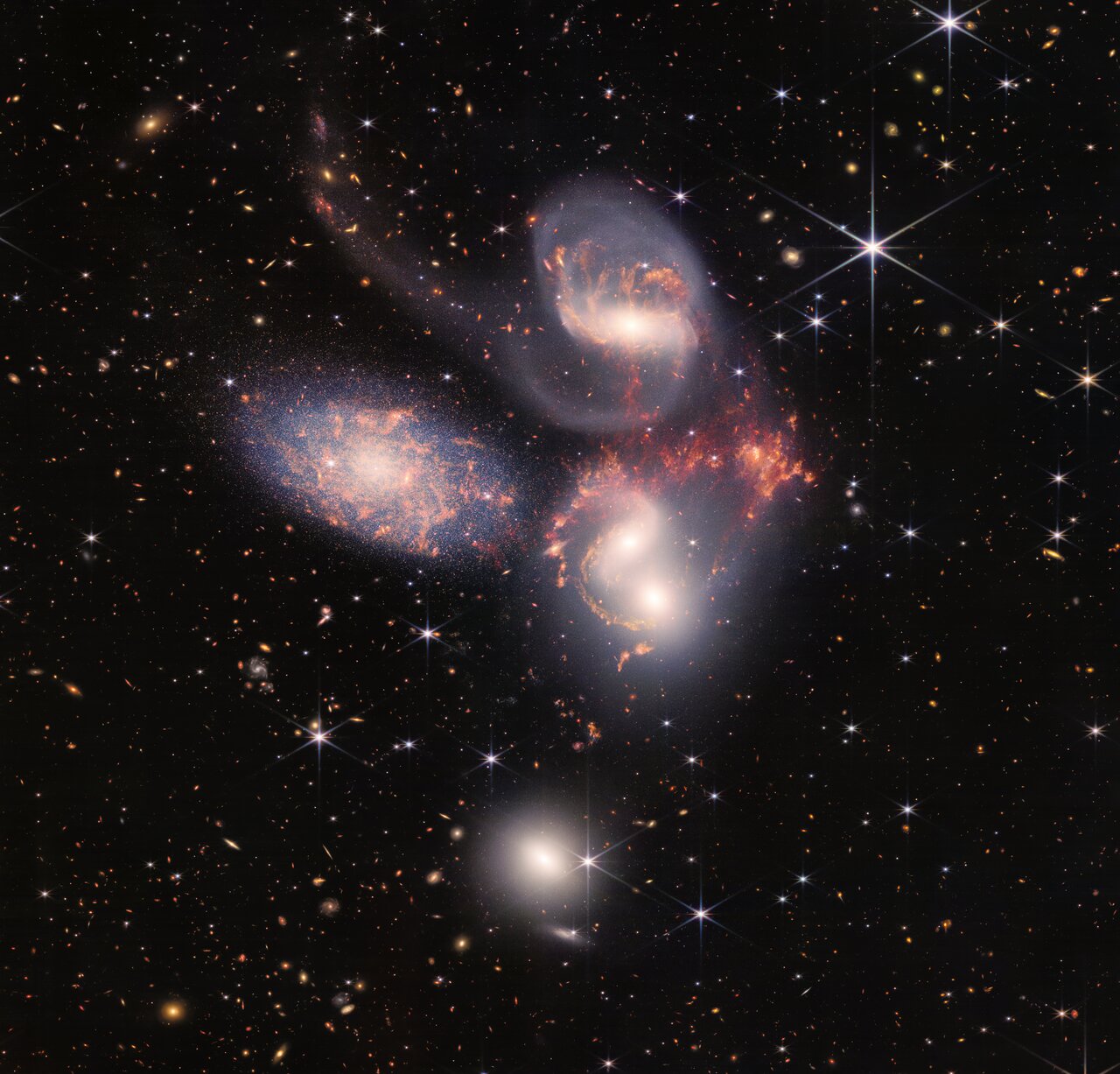
On 12 July 2022, as part of Webb's first image package, ESA/Webb released a large mosaic of Stephan's Quintet. Close proximity gives astronomers a ringside seat to galactic mergers and interactions. Webb's infrared view resolves dusty star-forming regions, shocked interfaces between colliding gas streams, and structures linked to an active galactic nucleus.
Compact groups like this may have been more common in the early Universe, when dense environments and gas-rich encounters fueled luminous black holes and rapid morphological change.
Webb's July 2022 first-light mosaic weic2208 resolved dusty star-forming regions and shocked gas among interacting galaxies, with one foreground interloper still mixed on the sky.
Shocked interfaces between colliding gas streams appear in the weic2208 mosaic alongside tidal debris.
Why it matters
Galaxy evolution is not only about isolated spirals fading into ellipticals. Groups and clusters force galaxies to share gas, strip disks, and ignite bursts of star formation. Stephan's Quintet compresses those processes into a single field that learners can study without traveling to high redshift. Infrared astronomy is crucial because dust hides much of the star formation and because warm molecular gas lights up where shocks heat the interstellar medium.
Galaxy merger processes that were common in early epochs appear locally in Stephan's Quintet, teachable without high-redshift confusion.
Compact groups like this may resemble environments where early-Universe mergers were more frequent.
How it was measured
Webb combined imaging and spectroscopy across near- and mid-infrared bands. Imaging maps morphology; spectra separate shock excitation, star formation, and AGN-powered emission. Multiwavelength context from Hubble, Spitzer, and radio maps remains essential: Webb adds infrared resolution and sensitivity rather than replacing the entire archive.
Near- and mid-infrared imaging plus spectroscopy in weic2208 separate shock excitation, star formation, and active galactic nucleus emission across the group.
Mid-infrared bands in weic2208 highlight polycyclic aromatic hydrocarbons in star-forming complexes.
What scientists thought before
Stephan's Quintet was already famous optically and in radio and X-ray data for tidal tails, a giant shock, and the pedagogical trap of a bright foreground interloper. Compact-group researchers already treated interactions and AGN feedback as co-present engines. What remained hard was resolving dust-obscured star formation and warm molecular responses at the clarity Webb's infrared mosaic provides. The prior picture was dynamical and multiwavelength; Webb was expected to update the infrared chapter of an established laboratory.
What remains uncertain
Which gas parcels will form stars, which will be heated into a multiphase halo, and how long AGN feedback can quench or redistribute fuel are open modeling questions. The interloper galaxy reminds readers that sky proximity is not always physical proximity. Cosmic Gateway keeps weic2208 as the public anchor while insisting on redshift-aware reading of every dramatic feature. Galaxy groups occupy a middle ground between isolated field galaxies and rich clusters. Encounters are frequent enough to matter, yet the systems are still individually resolvable. Stephan's Quintet compresses tidal tails, shocks, and AGN feedback into one mosaic that can be taught without requiring a deep-field statistical sample first.
Infrared astronomy changes which chapters are legible. Dust-obscured star formation becomes countable; warm molecular gas heated by shocks becomes visible; buried AGN structures become less cryptic. Optical morphology alone understates the energy budget. Cosmic Gateway therefore treats weic2208 as a methods image as much as a celebrity field.
Readers should also practice projection hygiene. One bright member is a foreground spiral; treating every overlapping silhouette as a merger is a classic error. Redshifts and velocity maps are the antidote. The learning habit — check distance before narrative — matters more than memorizing the quintet's nickname.
Projection of the foreground spiral can mimic interaction features unless redshifts anchor which galaxies truly participate in each galaxy merger episode.
Key sections
- What happened
- Webb released a large infrared mosaic of Stephan's Quintet resolving interacting galaxies, shocked gas, triggered star formation, and AGN-related outflows.
- Why it matters
- Compact groups illustrate how mergers and feedback reshape galaxies — processes that were likely common in the early Universe.
- How it was measured
- Near- and mid-infrared imaging plus spectroscopy map dusty star formation, shocks, and AGN-powered emission across the group.
- Prior understanding
- The quintet was already famous optically and in radio/X-ray for shocks and tidal features; one member is a foreground interloper.
- What remains uncertain
- Dynamical histories, gas fates, and AGN feedback efficiency remain model-dependent; projection can mimic interaction.
Build understanding
- Galaxy merger
The gravitational encounter and eventual coalescence of two or more galaxies.
- Infrared astronomy
Observing the universe in infrared light to see cool dust, embedded stars, and redshifted galaxies.
Related lesson
- Why Infrared Sees the Early Universe
Learn how cosmic expansion shifts ancient starlight into infrared wavelengths that Webb is built to collect.
Related discoveries
Continue through nearby stories that share instruments, objects, or ideas.
- Webb's New Look at the Cartwheel Galaxy
A ring galaxy forged by a head-on collision, seen in infrared dust and star formation.
Galaxy interactions that drive new structure and star formation.
- Webb's Infrared View of Starburst Galaxy M82
A nearby galactic wind laboratory lit by intense star formation.
Violent star formation and interacting systems.
Sources
Primary sources first. News tips are secondary signals, not the canonical account.
- Webb Sheds Light on Galaxy Evolution, Black Holes
Primary · official release · ESA / Webb