Clearest Image Yet of Betelgeuse's Elusive Companion
VLT/SPHERE captures strong visual evidence that the red supergiant is not alone.
Learning terms
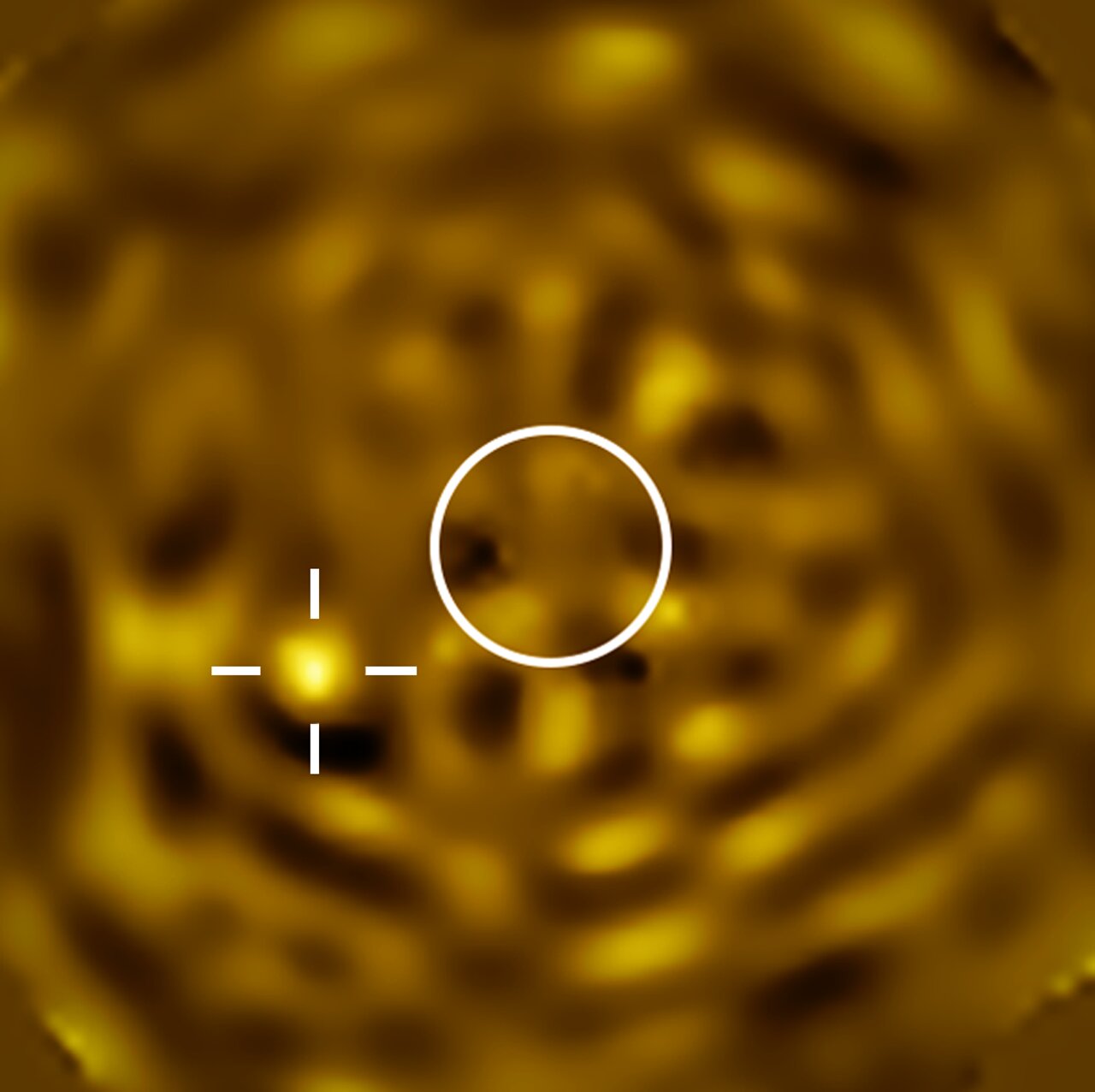
Version 1 · Initial Betelgeuse pilot discovery.
What happened
A team led by Miguel Montargès used the SPHERE instrument on ESO's Very Large Telescope to image a faint source consistent with Betelgeuse B, a companion orbiting the red supergiant Betelgeuse. The observation was timed for a predicted maximum elongation, when the companion should be easiest to separate from the primary's overwhelming glare.
The result, reported through an ESO release and a peer-reviewed Astronomy & Astrophysics paper, is the clearest visual evidence yet that Betelgeuse is part of a binary star system. For about a century, astronomers had suspected a companion from long brightness cycles and other clues. This campaign turns that suspicion into a resolved point source next to one of the sky's most familiar stars.
The candidate sits close enough that ordinary imaging would drown it. SPHERE's coronagraph and adaptive optics suppress Betelgeuse's light so a much fainter neighbor can emerge. That technical leap is why the same exoplanet-hunting toolkit now answers a classical stellar puzzle.
Why it matters
Betelgeuse's brightness changes for more than one reason. Dust ejections and pulsations explained dramatic dimming episodes in recent years, but a longer secondary period kept the companion idea alive. A gravitationally bound partner could help shape that longer cycle and may influence the red supergiant's wind, surface activity, and late evolution.
The discovery also matters pedagogically. It shows that instruments built for one frontier — imaging exoplanets — can reopen older questions about nearby giants. Learning terms such as Betelgeuse, red supergiant, binary star, and coronagraph make the measurement intelligible.
For Cosmic Gateway readers, the story is also a source lesson. Space.com and similar outlets can tip you to a result. The durable account lives in the facility release and the journal paper, where methods, significance, and caveats are stated carefully.
How it was measured
SPHERE combines extreme adaptive optics with a coronagraph that blocks most of Betelgeuse's light. High-contrast post-processing then searches for a faint point source at the predicted separation and position angle. The published analysis reports a detection at high significance, with an estimated companion mass of roughly two to three solar masses if the stars formed together and share an age.
That mass estimate is model-dependent. It assumes coevality and uses brightness plus evolutionary tracks. The key observational claim is simpler: a compact source appears where a companion should be when elongation is favorable. Timing relative to earlier predictions strengthens the interpretation beyond a random speck in residual starlight.
Readers should separate the imaging detection from later dynamical proof. Seeing a source once at the right place is powerful. Watching it move to the other side of the orbit is how astronomers cement that the source is gravitationally bound rather than a chance alignment or residual artifact.
What scientists thought before
For decades, Betelgeuse was treated as a solitary red supergiant whose variability came from pulsations, convection, and dust. The companion hypothesis never fully died because some photometric and spectroscopic patterns looked hard to explain with a single star alone. Earlier work around 2024 sharpened the case by predicting when a putative companion would reach favorable separation for direct imaging — roughly late 2024.
That forecast set up the VLT/SPHERE campaign. In other words, this was not a lucky snapshot. It was a planned observation guided by orbital expectations. The prior understanding was therefore mixed: dust and pulsations were established for short-term dimming, while a binary explanation remained plausible for longer cycles and awaited a decisive visual test.
What remains uncertain
The team still wants a second-epoch observation on the other side of the orbit to confirm that the source moves as a bound companion should. Until then, the evidence is strong but not absolute. Chance alignments and residual speckles can still be debated in good faith.
Uncertainty also remains about how strongly the companion shapes Betelgeuse's future — including mass loss and the path toward a supernova. Responsible reading keeps those open questions visible while still explaining why the image is a breakthrough. If you leave this Learn layer with one habit, ask what was imaged, what still needs orbital confirmation, and which concept unlocks the next sentence.
Key sections
- What happened
- VLT/SPHERE imaged a faint source consistent with Betelgeuse B near the red supergiant Betelgeuse.
- Why it matters
- A binary companion could help explain long brightness cycles and affect Betelgeuse's evolution.
- How it was measured
- A coronagraph and high-contrast imaging suppressed Betelgeuse's glare to reveal the companion candidate.
- Prior understanding
- Astronomers suspected a companion for about a century; recent work predicted a favorable 2024 elongation.
- What remains uncertain
- A second-epoch observation is still needed to fully confirm orbital motion of the companion.
Build understanding
- Betelgeuse
A bright red supergiant star in Orion, famous for changing brightness and nearing the end of its life.
- Red supergiant
A huge, cool, evolved star that has swollen after burning through much of its hydrogen fuel.
- Binary star
A system of two stars orbiting a shared center of mass, bound by gravity.
- Coronagraph
An optical device that blocks a bright star's light so fainter nearby objects can be seen.
Related discoveries
Continue through nearby stories that share instruments, objects, or ideas.
- Webb Captures Wolf-Rayet 124's Winds and Dust
A rare massive star sheds shells of gas and dust on the road toward a supernova.
Evolved massive stars and the winds that shape them.
- Webb's Infrared View of the Crab Nebula
Dust, filaments, and the pulsar-powered remnant of a historic supernova.
Massive-star evolution toward supernova remnants.
Sources
Primary sources first. News tips are secondary signals, not the canonical account.
- Astronomers find strongest evidence yet that Betelgeuse has a companion
Primary · official release · ESO
- VLT/SPHERE images of the candidate companion of Betelgeuse
Primary · paper · Astronomy & Astrophysics
- Betelgeuse, Betelgeuse! Astronomers capture clearest image yet of famous star's elusive companion
Secondary tip / news · Space.com