Webb's Cosmic Cliffs in the Carina Nebula
A glittering edge of star birth sculpted by radiation from massive stars.
Learning terms
Version 1 · Launch-batch seed: Cosmic Cliffs Carina.
What happened
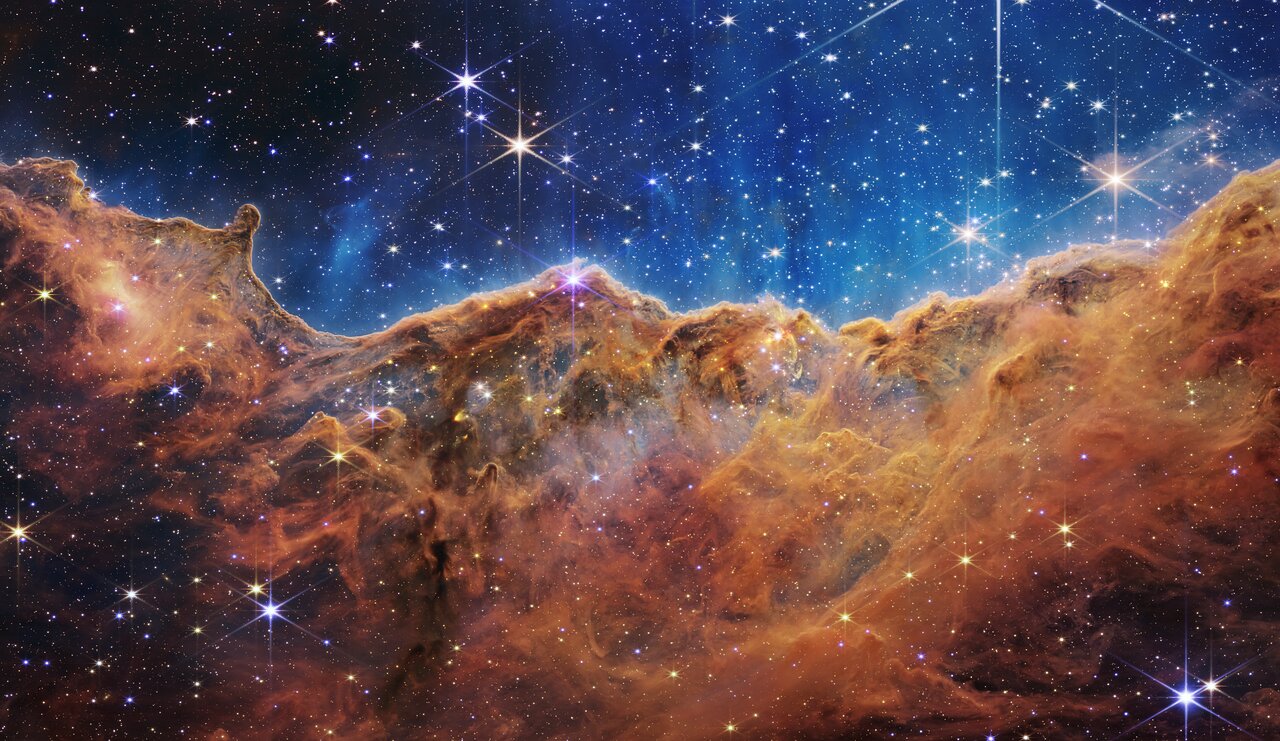
In July 2022, NASA, ESA, and the Canadian Space Agency released Webb's NIRCam portrait of the Cosmic Cliffs, the dusty rim of NGC 3324 at the edge of the Carina Nebula, roughly 7,600 light-years away. The image shows a wall of cold gas and dust being sculpted by ultraviolet radiation and stellar winds pouring off young, massive stars just out of frame above the ridge.
Where earlier optical and even some infrared images showed a soft, hazy boundary, Webb's near-infrared sensitivity resolves dozens of previously hidden protostars, bubbles carved by outflows, and thin jets of material launched from stars still gathering mass. The official ESA/Webb and NASA release (weic2205) frames the image as a portrait of star formation caught in the act, not a finished census.
Why it matters
The Cosmic Cliffs image matters because it turns an abstract idea — feedback from massive stars — into something visible. Massive stars are so luminous and energetic that their radiation and winds both trigger and destroy star formation nearby, and Carina's edge shows both processes happening within the same frame.
For learners, the picture is a case study in how infrared astronomy changes what counts as "empty" space. Regions that looked like dark, featureless dust in visible light turn out to be dense with activity once observed at longer wavelengths. That shift in what is visible is itself a lesson about the limits of any single instrument.
The image also reinforces that star formation is rarely a tidy, one-directional process. Cavities blown by winds can compress nearby gas and trigger new collapse, while the same winds erode material that might otherwise have formed more stars later. Cosmic Gateway keeps that tension visible rather than flattening it into a simple origin story.
How it was measured
Webb's NIRCam captured the scene in near-infrared light across several filters, each tuned to particular temperatures and molecular signatures. Longer infrared wavelengths pass through dust more easily than optical light, letting the camera see embedded protostars and the ionization fronts where hot stellar radiation meets the cooler cloud surface.
Physical scale and distance for NGC 3324 come from earlier studies of the broader Carina Nebula complex; Webb's contribution is spatial resolution and sensitivity, not the underlying distance measurement. Confirming which bright points are genuine protostars, versus reflected light or background stars, still requires spectroscopy and follow-up catalogs rather than the image alone.
What scientists thought before
Ground- and space-based infrared surveys, including Spitzer, had already mapped some star formation and outflow activity around NGC 3324 before Webb. Optical images from Hubble and ground observatories showed the cliffs as a hazy, glowing edge, hinting at ongoing activity without resolving individual protostars clearly.
The broad picture — massive stars sculpting their birth clouds through feedback — was well established from decades of study of similar regions like the Eagle and Orion nebulae. What Webb added was resolution: a much sharper, more complete inventory of the protostars and structures already predicted by that general feedback picture.
What remains uncertain
Exact stellar ages, masses, and the balance between triggered and suppressed star formation in this particular ridge remain open questions that require spectroscopic follow-up and modeling, not just imaging.
Next time you see a strikingly detailed nebula image, ask which wavelength made it possible and what physical process — birth, erosion, or both — the picture is actually showing. From here, the star-formation and infrared-astronomy concept pages are the natural next stop.
A useful habit when reading any nebula portrait like this one is to check whether a bright point has been confirmed by spectroscopy or only looks suggestive in a single filtered image; that check is what separates a measured census from an evocative impression.
Key sections
- What happened
- Webb's NIRCam imaged the Cosmic Cliffs — a radiation-carved edge of star-forming gas in the Carina Nebula — among the observatory's first public releases.
- Why it matters
- It shows how massive-star feedback shapes nurseries and how infrared light reveals stars still hidden by dust.
- How it was measured
- Near-infrared mosaics from NIRCam map young stars, dust, and ionization-front structure along the cavity rim in NGC 3324.
- Prior understanding
- Carina was already a known massive-star laboratory; optical and earlier infrared views lacked Webb's near-infrared sharpness at this rim.
- What remains uncertain
- Whether radiation triggered specific young stars, and precise ages along the rim, still depend on spectroscopy and models.
Build understanding
- Star formation
The process by which dense clouds of gas and dust collapse under gravity to form new stars.
- Infrared astronomy
Observing the universe in infrared light to see cool dust, embedded stars, and redshifted galaxies.
Related lesson
- Why Infrared Sees the Early Universe
Learn how cosmic expansion shifts ancient starlight into infrared wavelengths that Webb is built to collect.
Related discoveries
Continue through nearby stories that share instruments, objects, or ideas.
- Webb's Infrared View of Sagittarius C
A star-forming complex near the Milky Way's center, revealed through dust.
Crowded star-forming environments in infrared light.
- Webb's Star-Filled Portrait of the Pillars of Creation
Infrared light turns Hubble's iconic towers into a nursery of forming stars.
Two Webb portraits of star-forming gas and dust.
Sources
Primary sources first. News tips are secondary signals, not the canonical account.
- Webb reveals the Cosmic Cliffs in the Carina Nebula
Primary · official release · ESA / Webb
- NASA's Webb Reveals Cosmic Cliffs, Glittering Landscape of Star Birth
Primary · official release · NASA