Webb's Star-Filled Portrait of the Pillars of Creation
Infrared light turns Hubble's iconic towers into a nursery of forming stars.
Learning terms
Version 1 · Launch-batch seed: Pillars of Creation Webb portrait.
What happened
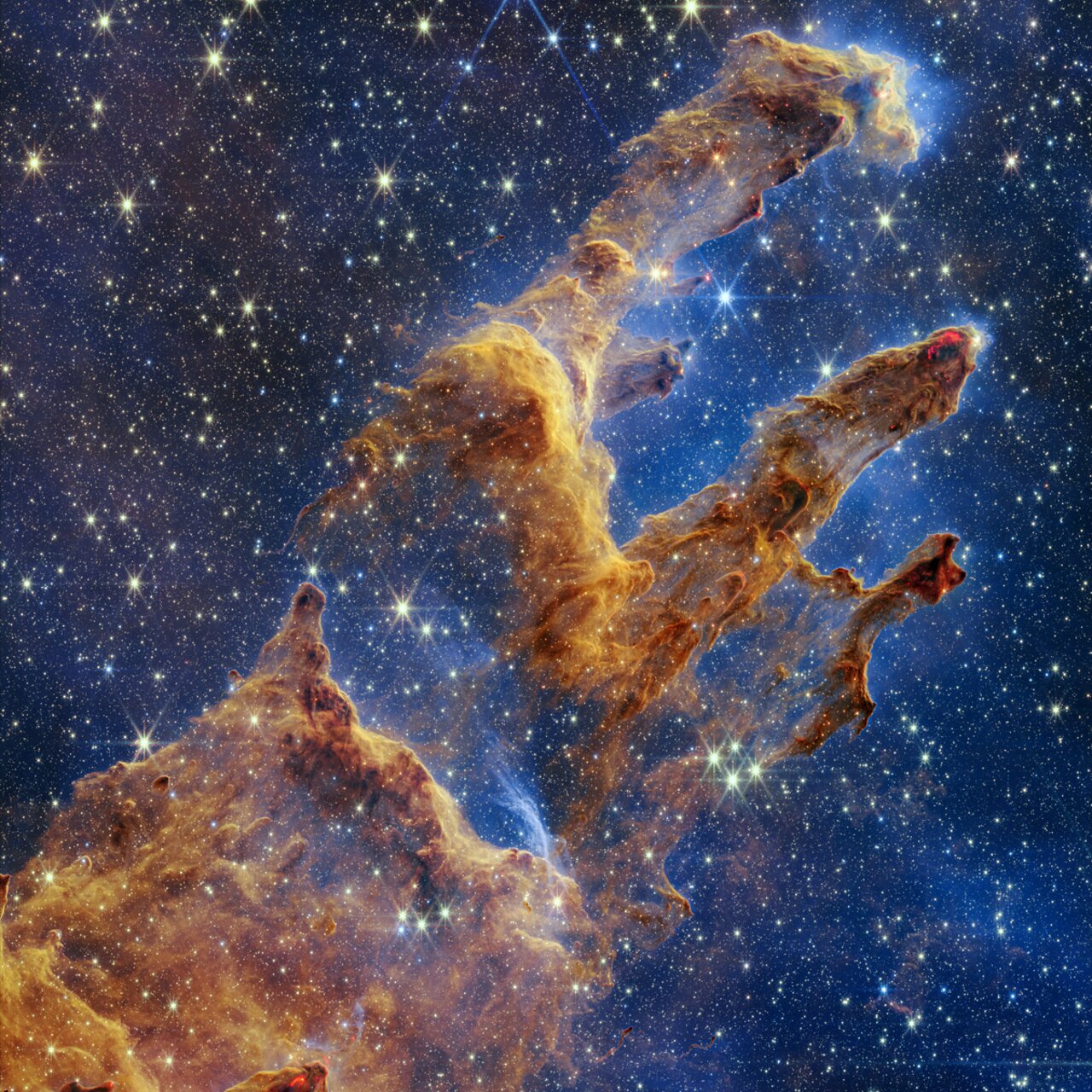
In October 2022, the James Webb Space Telescope released a near-infrared portrait of the Pillars of Creation, the famous dusty towers in the Eagle Nebula (M16). Hubble's optical image made the pillars iconic as silhouettes against a glowing background. Webb's NIRCam image instead reveals stars forming within and around the columns, because infrared light penetrates much of the obscuring dust.
The pillars are dense ridges of cold gas and dust sculpted by ultraviolet radiation and winds from nearby massive stars. Webb's sharper infrared sensitivity turns those ridges into a map of embedded young stellar objects, jets, and glowing interfaces where energy from hot stars meets cooler material. Official ESA/Webb and NASA releases (weic2216) present the public image and narrative that Cosmic Gateway treats as primary doors into the result.
Why it matters
Star formation is usually hidden. Dust absorbs optical light, so optical telescopes often see only the outline of a nursery. Infrared astronomy opens the interior. For learners, the Pillars of Creation become a concrete lesson: the same region can look opaque or transparent depending on wavelength, and that difference is not aesthetic — it is physical.
The result also connects public memory to modern methods. A landmark Hubble image becomes a before-and-after for how observatories choose wavelengths to answer different questions. Cosmic Gateway treats that comparison as pedagogy, not nostalgia. Linking the star-formation and infrared-astronomy concepts keeps the postcard from becoming a dead end: birth physics and dust opacity travel together.
The pillars also remind readers that "discovery" in a learning product is not always a brand-new object. Sometimes the advance is a clearer measurement of a known region. That distinction should travel with every future "new look at an old object" headline on Cosmic Gateway.
How it was measured
Webb's Near-Infrared Camera (NIRCam) collected light at wavelengths longer than the human eye can see. Dust scatters and absorbs shorter wavelengths more effectively, so near-infrared photons escape denser regions more readily. Filters isolate structures at different depths and temperatures; combined color composites highlight young stars, reflection, and emission from heated dust and gas.
Distance and physical scale come from prior Eagle Nebula studies. Webb's contribution is resolution and infrared sensitivity, not a first discovery of the pillars themselves. Catalogs of young stellar objects and spectra still sort which bright knots are newborn stars, which are heated dust, and which are background interlopers. Without that sorting, "star-filled" remains a metaphor rather than a measured census.
What scientists thought before
Before Webb, Spitzer and ground-based infrared surveys already showed that the pillars contain young stars. Hubble and multiwavelength campaigns mapped erosion and structure in M16. The prior picture was that photoevaporating towers host embedded star formation — expected, not shocking. What was incomplete was the near-infrared spatial census at Webb's resolution, and the public's ability to see the interior as clearly as the silhouette.
The scientific narrative is therefore continuous rather than revolutionary. Embedded star formation was anticipated. The value is a clearer census and a durable teaching image for infrared astronomy: wavelength choice as a scientific instrument, not a filter for prettier colors. Earlier optical culture over-taught the silhouette and under-taught the dusty interior; Webb rebalances that public memory without rewriting the underlying physics.
What remains uncertain
Individual stellar ages, masses, and accretion rates still require spectroscopy and careful modeling. The pillars are evolving; radiation and winds continue to erode them. An image freezes one moment in a dynamical environment. Photoevaporation timescales and the balance between triggered and spontaneous collapse remain active research threads.
If you leave this Learn layer with one habit, make it this: when an image looks transformed, ask whether the telescope changed the object — or only the wavelengths you can see. From here, open the star-formation and infrared-astronomy concept pages, then try the linked lesson on why infrared light reveals what dust hides.
Key sections
- What happened
- Webb's NIRCam imaged the Pillars of Creation in near-infrared light, revealing young stars embedded in dusty towers that look opaque in optical views.
- Why it matters
- It shows how infrared astronomy opens dust-obscured star-forming regions and turns an iconic silhouette into a map of ongoing birth.
- How it was measured
- Near-infrared imaging with Webb's NIRCam penetrates dust that blocks visible light, mapping young stars and heated interfaces in the Eagle Nebula.
- Prior understanding
- Hubble made the pillars famous optically; earlier infrared surveys already hinted at embedded young stars with less resolution.
- What remains uncertain
- Ages and masses of individual young stars need spectroscopy and modeling; the pillars continue to erode over time.
Build understanding
- Star formation
The process by which dense clouds of gas and dust collapse under gravity to form new stars.
- Infrared astronomy
Observing the universe in infrared light to see cool dust, embedded stars, and redshifted galaxies.
Related lesson
- Why Infrared Sees the Early Universe
Learn how cosmic expansion shifts ancient starlight into infrared wavelengths that Webb is built to collect.
Related discoveries
Continue through nearby stories that share instruments, objects, or ideas.
- Webb's Cosmic Cliffs in the Carina Nebula
A glittering edge of star birth sculpted by radiation from massive stars.
Two Webb portraits of star-forming gas and dust.
- Webb's Detailed Portrait of Herbig-Haro 46/47
Near-infrared imaging resolves twin jets from a pair of forming stars in Vela.
From pillars of gas to resolved protostellar jets.
Sources
Primary sources first. News tips are secondary signals, not the canonical account.
- Webb takes a star-filled portrait of the Pillars of Creation
Primary · official release · ESA / Webb
- NASA's Webb Takes a Star-Filled Portrait of Pillars of Creation
Primary · official release · NASA