Early Galaxies Challenge Simple Growth Models
Webb's infrared view finds unexpectedly developed structure soon after the Big Bang.
Learning terms
Version 1 · Initial published version for seed content.
What happened
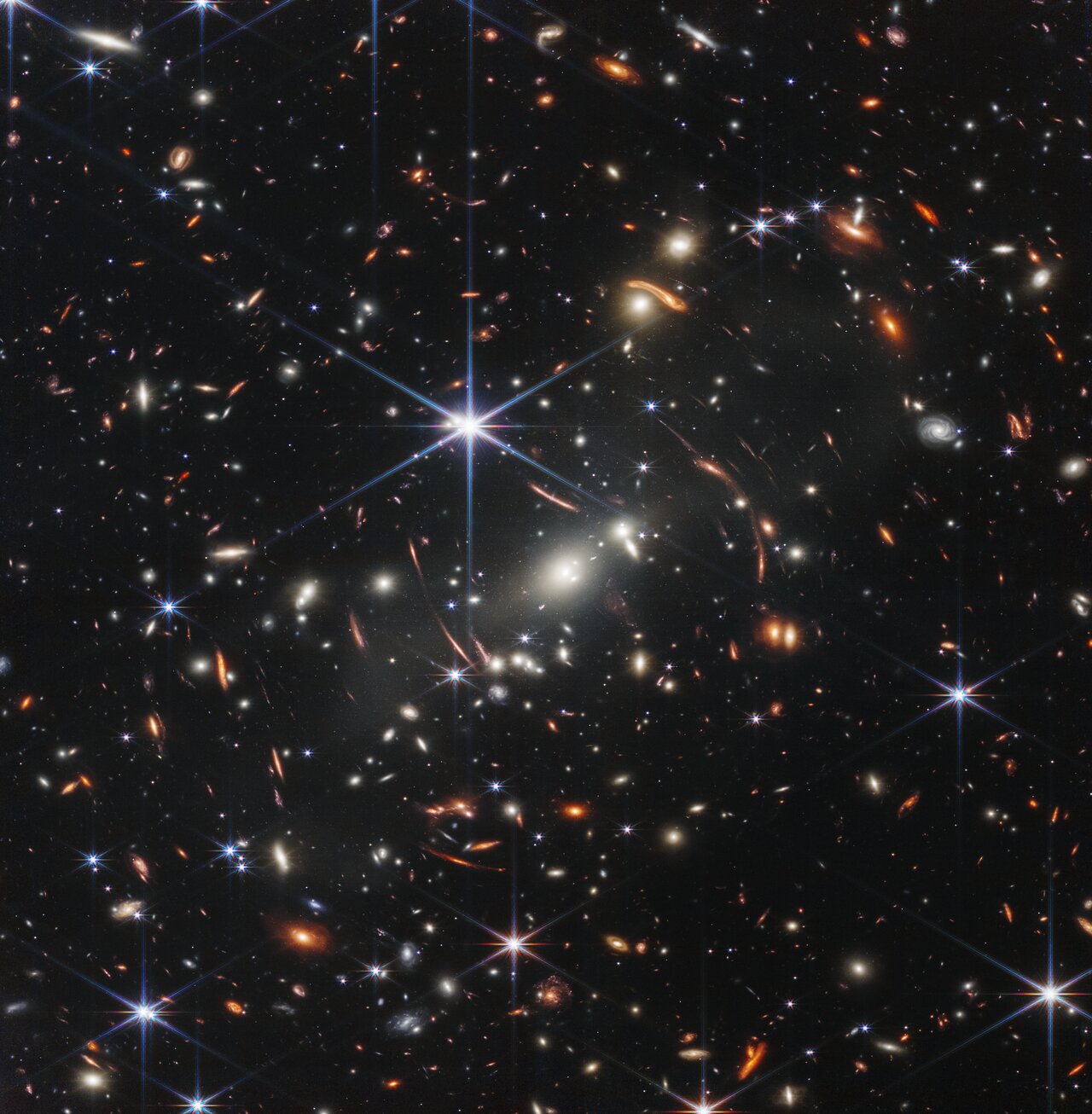
Observations with the James Webb Space Telescope uncovered distant galaxies that appear more mature than expected for cosmic dawn. In deep infrared images, some systems are luminous enough — and structured enough — that they challenge the most naive versions of early galaxy growth.
Webb sees this population because cosmic expansion stretches ancient ultraviolet and optical light into the infrared. What once required heroic guesses from Hubble and ground-based surveys is now a systematic infrared census. Deep fields such as SMACS 0723 are not just postcard images; they are dense catalogs of galaxies across cosmic time, stacked into a single frame.
The surprise is quantitative as well as visual. Some candidates imply stellar masses or star-formation rates that press against simple expectations for how quickly gas could cool and form stars so soon after the Big Bang. That pressure is scientifically useful only when distance and luminosity are measured carefully.
Why it matters
Galaxy formation is a bridge between dark matter, gas physics, and star formation. If stars assembled quickly in early dark matter halos, then cooling, feedback, and chemical enrichment timelines need revision. This is not only a pretty-picture story. It is a stress test of how cosmic structure forms.
For learners, the discovery is also a gateway into three durable ideas: redshift as look-back time, spectroscopy as distance confirmation, and the difference between a candidate and a confirmed high-redshift galaxy. Once those ideas click, future headlines become easier to evaluate instead of easier to overreact to.
Public understanding also benefits from patience. Early Webb papers and press releases arrived quickly. Follow-up spectra, larger samples, and independent teams then sorted durable results from temporary surprises. A learning product should teach that process, not hide it.
How it was measured
Webb's NIRCam imaging identifies color-selected candidates. Photometric redshifts estimate distance from those colors by comparing observed brightness across filters with model galaxy templates. Spectroscopy — with instruments such as NIRSpec — confirms redshift by measuring spectral features shifted by expansion.
That pipeline matters for reading headlines. An exciting candidate can become less extreme after a spectrum, or remain surprising after confirmation. Evidence status on Cosmic Gateway is meant to keep that distinction visible. When a claim rests on photometry alone, uncertainty should be louder than the headline.
Additional complications include gravitational lensing, which can magnify background galaxies behind massive clusters, and dust, which can hide or reshape the light we use to infer stellar mass. Active galactic nuclei can also dominate an object's brightness and complicate interpretations framed purely in terms of stars.
What scientists thought before
Before Webb, hierarchical models and earlier surveys sketched an early universe of relatively small, messy star-forming systems assembling gradually through mergers. Extremely luminous galaxies at the highest redshifts were expected to be rare. Hubble had already found remarkable distant objects, but the infrared window remained incomplete.
The prior picture was not wrong so much as incomplete. Cosmology still expects structure to grow from small to large. The open question is the efficiency and timing of star formation inside the earliest dark matter halos — how fast baryons convert into stars, and how feedback regulates that conversion.
What remains uncertain
Some early claims relied on photometric estimates alone. Dust, gravitational lensing, active nuclei, and redshift errors can all inflate apparent maturity. Larger spectroscopic samples decide which surprises survive. Responsible reading preserves uncertainty while still explaining why the result is interesting.
If you leave this Learn layer with one habit, make it this: ask how distance was measured, what could fake the signal, and which concept you need next. From here, open the redshift and spectroscopy concept pages, then try the linked lesson on why infrared sees the early universe.
Key sections
- What happened
- Webb identified distant galaxies that look more luminous and structured than many early-universe models anticipated.
- Why it matters
- It pressures theories of how quickly stars and structure can assemble after the Big Bang.
- How it was measured
- Infrared imaging finds candidates; spectroscopy confirms redshift and physical conditions.
- Prior understanding
- Earlier surveys suggested smaller, messier systems assembling more gradually.
- What remains uncertain
- Some candidates still need spectroscopic confirmation; brightness can have multiple causes.
Build understanding
- Redshift
A stretching of light toward longer wavelengths as the universe expands, used to measure cosmic distance and look-back time.
- Spectroscopy
Splitting light into wavelengths to measure composition, motion, and redshift of astronomical objects.
Related lesson
- Why Infrared Sees the Early Universe
Learn how cosmic expansion shifts ancient starlight into infrared wavelengths that Webb is built to collect.
Related discoveries
Continue through nearby stories that share instruments, objects, or ideas.
- Webb Peers Through Pandora's Cluster
Gravitational lensing turns a massive cluster into a natural telescope for distant galaxies.
Distant galaxies — direct deep fields and cluster lenses.
- Euclid's View of the Perseus Cluster of Galaxies
A wide, sharp look at a massive cluster where dark matter shapes the cosmic web.
From early-galaxy tension to wide-field cosmology mapping.
Sources
Primary sources first. News tips are secondary signals, not the canonical account.
- NASA's Webb Delivers Deepest Infrared Image of Universe Yet
Primary · official release · NASA
- Early galaxy formation in the JWST era (illustrative seed source)
Primary · paper · arXiv / peer-reviewed literature