Webb Peers Through Pandora's Cluster
Gravitational lensing turns a massive cluster into a natural telescope for distant galaxies.
Learning terms
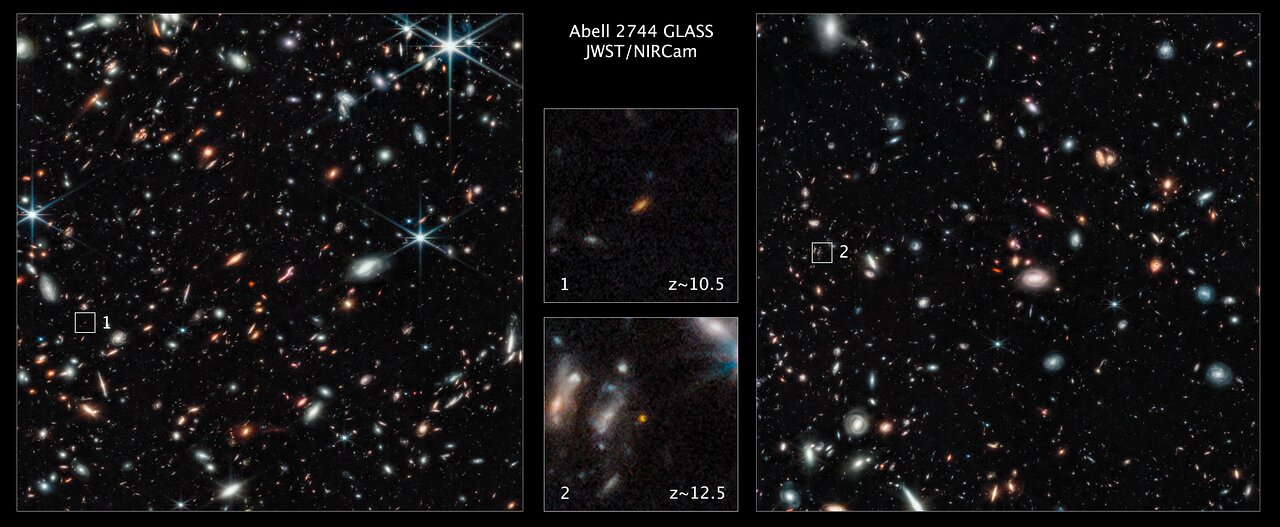
Version 1 · Expansion-batch seed: Pandora's Cluster lensed galaxies.
What happened
ESA/Webb published deep infrared imaging of Pandora's Cluster, highlighting both the cluster's complex assembly and the multitude of background galaxies stretched into arcs and magnified images. Abell 2744 earned its nickname because multiple mass clumps and hot-gas structures make it a messy, informative merger of clusters.
Webb's sensitivity at infrared wavelengths helps detect distant, red, dust-obscured, or highly redshifted sources that optical surveys undercount.
ESA/Webb published deep infrared imaging of Pandora's Cluster Abell 2744 (weic2220), revealing lensed background galaxies in a merging cluster.
Multiple images of background galaxies appear when Abell 2744 lenses distant sources in weic2220.
Why it matters
Gravitational lensing is both a tool and a measurement. As a tool, it brightens galaxies too faint to study otherwise. As a measurement, the pattern of distortions constrains the total mass distribution — dominated by dark matter. Pandora's Cluster is a classroom for both uses at once.
Gravitational lensing magnifies distant galaxies while mapping dark matter that does not shine but dominates the cluster mass budget.
Strong lensing magnifies galaxies too faint for spectroscopy without cluster assistance.
How it was measured
Imaging identifies multiple images and arcs; photometric redshifts prioritize follow-up; spectroscopy confirms source distances. Lens models fit mass distributions to reproduce image positions and magnifications. X-ray maps of hot gas add baryonic context, but the lensing mass includes dark matter that X-rays do not see directly.
Deep infrared imaging finds arcs and multiple images; lens models plus redshifts convert distortions into mass maps in the weic2220 field.
Deep stacking and infrared sensitivity in weic2220 reveal arcs missed by shallower optical surveys.
What scientists thought before
Abell 2744 was already a Frontier Fields lensing workhorse with rich X-ray and optical data, nicknamed Pandora's Cluster because multiple colliding subclusters make its mass distribution messy and informative. Gravitational lensing was already used both as a telescope for faint backgrounds and as a mass map dominated by dark matter. Webb was expected to deepen the infrared source catalog that feeds lens models — more arcs and candidates — rather than to introduce lensing as a new idea.
What remains uncertain
Complex merging clusters have multiple mass peaks; simple spherical models fail. Magnification estimates for individual galaxies carry systematic errors. Cosmic Gateway treats weic2220 as the public visual entry, then insists on lens-model caveats before any extreme claim about a single background galaxy's intrinsic brightness. Strong lensing turns clusters into telescopes with messy optics. Magnification is not uniform; it varies across the source plane and can produce multiple images of one galaxy. Pandora's Cluster is an especially instructive lens because it is mid-merger: multiple mass clumps complicate the optics and enrich the dark-matter test.
Webb's infrared depth expands the source catalog that lens modelers use. More arcs and candidates improve constraints — and also raise the burden of redshift confirmation. Cosmic Gateway emphasizes that chain: image beauty, then lens model, then intrinsic luminosity. Skipping the middle step turns astronomy into astrology of brightness.
Dark matter enters as the dominant lensing mass, not as a glowing substance in the frame. X-ray gas traces baryons that can separate from collisionless mass during mergers. When those tracers disagree, the disagreement is data. Official release weic2220 is the public start; mass-model papers are the workplace.
Cluster member galaxies themselves evolve through mergers and ram-pressure effects while lensing background sources. Pandora's Cluster therefore teaches foreground assembly and background magnification in one field — two stories that must not be conflated.
Infrared selection helps recover dusty or high-redshift sources whose optical light is suppressed. That selection gain is a major reason Webb cluster fields matter beyond prettier versions of Hubble arcs.
Multi-peak merging-cluster mass models make magnifications for individual lensed galaxies systematically uncertain without spectroscopic anchors.
Key sections
- What happened
- Webb imaged Pandora's Cluster in the infrared, revealing lensed background galaxies and structures in this complex merging cluster.
- Why it matters
- Gravitational lensing magnifies distant galaxies and maps dark matter in one of the messiest, most informative nearby clusters.
- How it was measured
- Deep infrared imaging finds arcs and multiple images; lens models plus redshifts convert distortions into mass maps and source properties.
- Prior understanding
- Abell 2744 was already a Frontier Fields lensing target with rich X-ray and optical data; Webb deepens the infrared source census.
- What remains uncertain
- Mass models for a multi-peak merging cluster are complex; magnifications for individual sources carry significant systematic uncertainty.
Build understanding
- Gravitational lensing
The bending of light by mass, which can magnify and distort background galaxies.
- Dark matter
Invisible matter inferred from gravity that outweighs ordinary atoms in galaxies and clusters.
Related lesson
- Why Infrared Sees the Early Universe
Learn how cosmic expansion shifts ancient starlight into infrared wavelengths that Webb is built to collect.
Related discoveries
Continue through nearby stories that share instruments, objects, or ideas.
- Euclid's View of the Perseus Cluster of Galaxies
A wide, sharp look at a massive cluster where dark matter shapes the cosmic web.
Clusters as dark-matter laboratories and natural telescopes.
- Early Galaxies Challenge Simple Growth Models
Webb's infrared view finds unexpectedly developed structure soon after the Big Bang.
Distant galaxies — direct deep fields and cluster lenses.
Sources
Primary sources first. News tips are secondary signals, not the canonical account.
- Webb takes a deep look at Pandora's Cluster
Primary · official release · ESA / Webb