GW170817: A Neutron Star Merger Seen in Waves and Light
Gravitational waves and a kilonova confirmed how heavy elements can form.
Learning terms
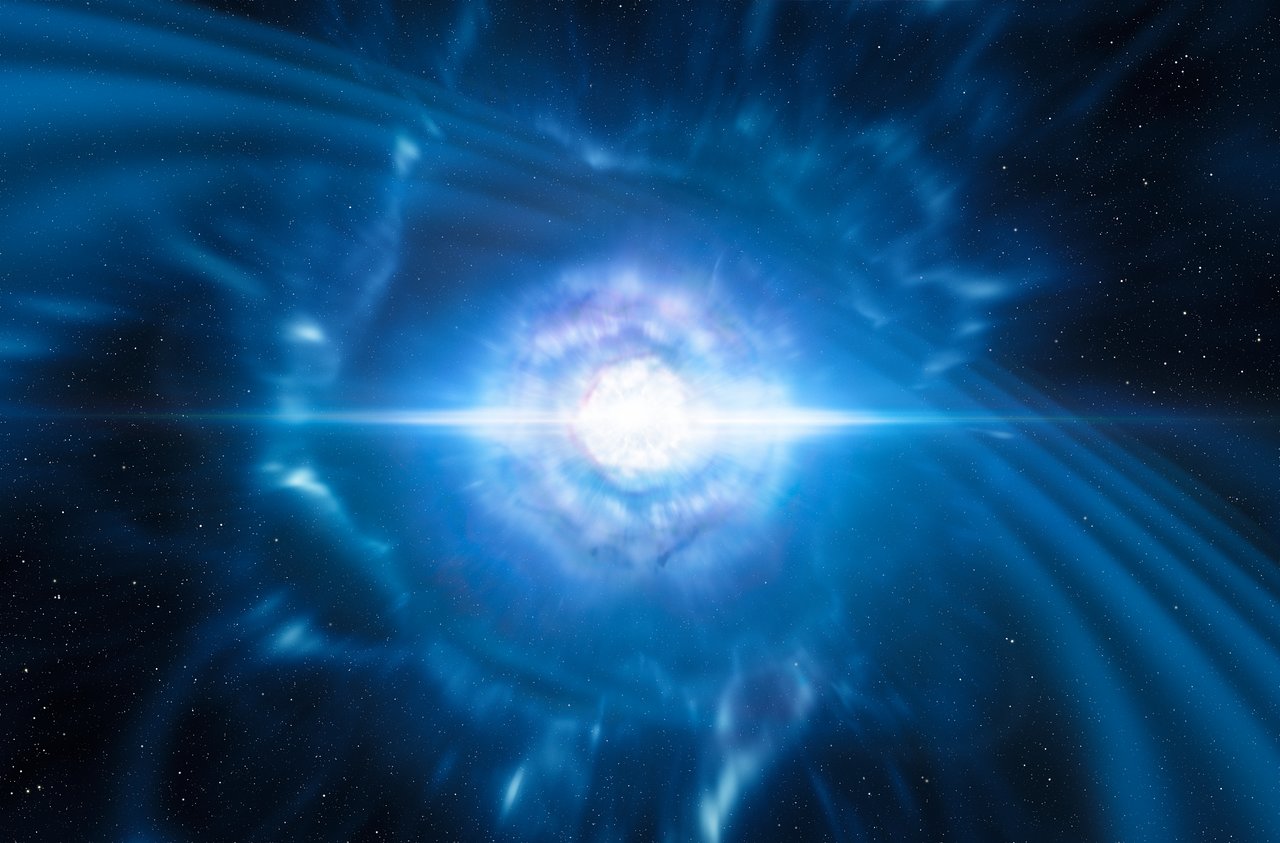
Version 1 · Launch-batch seed: GW170817 neutron star merger.
What happened
On August 17, 2017, the LIGO and Virgo gravitational-wave observatories detected a signal, designated GW170817, consistent with two neutron stars spiraling together and merging in the galaxy NGC 4993, roughly 130 million light-years away. Less than two seconds later, space-based gamma-ray observatories detected a short burst of gamma rays from a consistent direction, immediately suggesting a connection between the two signals.
Ground- and space-based telescopes worldwide then searched for and found a fading optical and infrared source at the location, informally called a kilonova, and designated AT2017gfo. The official ESO release (eso1733) described the intense, coordinated follow-up campaign involving dozens of observatories, framing the event as the first confirmed detection of both gravitational waves and electromagnetic light from the same astrophysical source.
Why it matters
GW170817 mattered because it inaugurated what astronomers now call multi-messenger astronomy: combining gravitational-wave signals with traditional light-based observations to study the same event from multiple independent physical channels. Before this event, gravitational-wave detections had come only from black hole mergers, which are not expected to produce detectable light.
The kilonova's spectrum also provided direct observational support for a decades-old theoretical idea: that neutron star mergers are a major source of the universe's heaviest elements, formed through rapid neutron capture, or the r-process. Gold, platinum, and other heavy elements found on Earth may trace their origin substantially to events like this one.
Linking the gravitational-wave and neutron-star concepts here keeps both halves of the story visible: the merger itself is detected through spacetime ripples, while its aftermath — the heavy-element factory — is studied through conventional light. Neither channel alone would have told the complete story.
How it was measured
LIGO and Virgo detect gravitational waves by measuring minute changes in the distance between mirrors suspended kilometers apart, changes caused by spacetime itself stretching and compressing as a wave passes. The pattern of the GW170817 signal was consistent with two compact objects of neutron-star-like mass spiraling together and merging.
Following the gravitational-wave and gamma-ray detections, astronomers used the rough sky location provided by the detector network to search a patch of sky with ground-based telescopes, finding the fading kilonova within hours. Spectra of that fading light, gathered over the following days and weeks by many observatories, revealed the changing chemical signatures consistent with freshly synthesized heavy elements cooling and expanding outward.
What scientists thought before
Before GW170817, theoretical work had proposed for decades that neutron star mergers could be a major site for r-process nucleosynthesis, competing with other proposed sites like certain supernovae, but direct observational evidence favoring neutron star mergers specifically had been lacking. Gravitational-wave astronomy itself was barely two years old, with LIGO's first detections in 2015 coming from black hole mergers, which produce no expected electromagnetic counterpart.
The broader theoretical framework connecting neutron star mergers, short gamma-ray bursts, and heavy-element production existed before 2017; what GW170817 provided was the first direct observational link tying all three together in a single, well-observed event.
What remains uncertain
How much of the universe's total gold, platinum, and other r-process elements originated from events like GW170817, versus rarer or more common merger scenarios, is still being worked out using population studies and computer models rather than this single event alone.
GW170817 is a reminder that some of the most important discoveries come from combining entirely different kinds of instruments looking at the same patch of sky in short order. From here, the gravitational-wave and neutron-star concept pages explain the physics behind both halves of this landmark event.
Key sections
- What happened
- LIGO/Virgo detected GW170817 from merging neutron stars, and telescopes including ESO facilities observed the kilonova counterpart.
- Why it matters
- It launched multi-messenger astronomy with light plus waves and showed mergers forge heavy elements.
- How it was measured
- Gravitational-wave interferometry localized the event; optical through radio follow-up tracked the kilonova and afterglow.
- Prior understanding
- Mergers were predicted sources of short GRBs and r-process elements, but a joint detection had not been secured.
- What remains uncertain
- Remnant type and detailed elemental yields remain model-sensitive despite the clear overall picture.
Build understanding
- Gravitational wave
A ripple in spacetime produced by accelerating massive objects, detected on Earth by laser interferometers.
- Neutron star
An extremely dense remnant of a massive star's core, packed mostly with neutrons after a supernova.
Related discoveries
Continue through nearby stories that share instruments, objects, or ideas.
- Webb Maps Cassiopeia A in Infrared Detail
A nearby supernova remnant shows clumpy debris and a cooling neutron-star heart.
Neutron stars as leftovers — and as gravitational-wave sources.
Sources
Primary sources first. News tips are secondary signals, not the canonical account.
- ESO telescopes observe first light from gravitational wave source
Primary · official release · ESO
- GW170817: Observation of gravitational waves from a binary neutron star inspiral
Primary · official release · LIGO Laboratory