First Image of a Black Hole: M87*
The Event Horizon Telescope resolves the shadow of a galaxy's central giant.
Learning terms
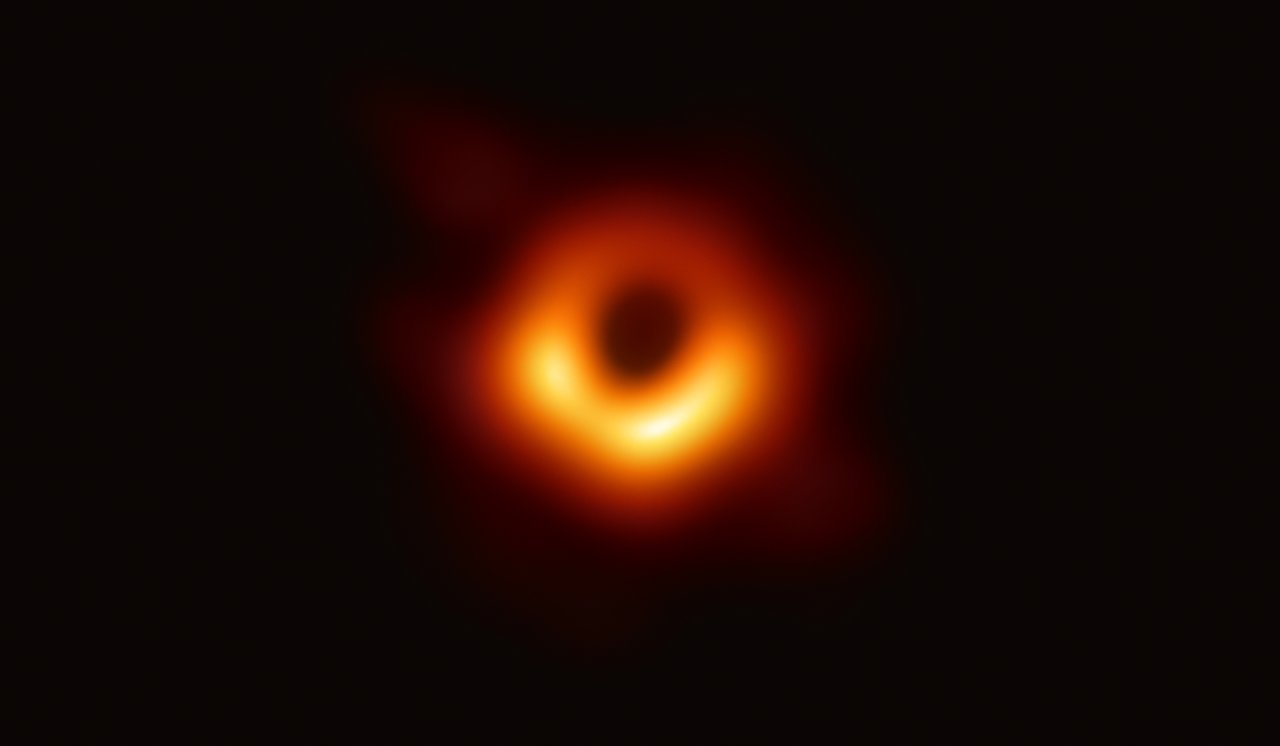
Version 1 · Launch-batch seed: M87* first black hole image.
What happened
On April 10, 2019, the Event Horizon Telescope (EHT) collaboration announced the first direct image of a black hole: the supermassive black hole at the center of the galaxy M87, about 55 million light-years away in the Virgo Cluster, with a mass of roughly 6.5 billion Suns. The image shows a glowing, ring-shaped structure surrounding a dark central region, matching the theoretically predicted shadow cast by a black hole's event horizon.
The official ESO release (eso1907) and simultaneous papers published by the EHT collaboration described years of coordinated observation, using radio telescopes on multiple continents linked together, followed by an extensive, independently cross-checked data processing effort to produce the final image.
Why it matters
This was widely described as the first time humanity had directly "seen" a black hole, and the description is broadly accurate: prior evidence for black holes, however strong, had always been indirect, based on the motion of stars or gas rather than a direct image of the region right at the edge of the event horizon. M87's image changed that.
For learners, the result is a powerful case study in how theory and observation can converge: general relativity had predicted the rough shape and size of a black hole shadow long before any telescope could resolve one, and the M87 image matched those predictions closely. That match strengthened confidence in general relativity in an extreme gravity regime that had never been directly tested before.
Linking the black-hole and event-horizon concepts here is central to understanding the image correctly: the dark region is not the black hole's true size but the shadow cast by light bending around it, a distinction that shapes how every subsequent black hole image, including Sgr A*'s, should be read.
How it was measured
The EHT used very long baseline interferometry, combining radio telescopes across the globe to synthesize the resolving power of a telescope roughly the size of Earth — the resolution required to see something as small, in angular terms, as a black hole's shadow at this distance. Data from each telescope had to be precisely time-stamped using atomic clocks and later combined computationally.
Because the resulting dataset was necessarily incomplete — no real telescope array covers Earth continuously — the collaboration used multiple independent imaging algorithms and rigorous blind analysis procedures, comparing results without cross-contamination between teams, before agreeing that the ring-like structure was a robust feature of the data rather than an artifact of any single processing method.
What scientists thought before
Before 2019, evidence for M87's central black hole was already strong: measurements of gas and stellar motions near the galaxy's center had indicated a compact, extremely massive object consistent with a supermassive black hole for years, and M87's relativistic jet, one of the most studied in astronomy, was understood to be powered by such an object.
What had not existed before was direct imaging of the region immediately surrounding the event horizon. The EHT project was specifically designed, years in advance, to attempt exactly this kind of observation on the two most promising targets, M87* and Sgr A*, making the 2019 result the fulfillment of a long-planned observational campaign rather than a surprise finding.
What remains uncertain
While the ring's overall size and shape matched general relativity's predictions well, the resolution achieved in 2019 could not resolve finer details of the accretion flow or magnetic field structure near the horizon; those details are the target of ongoing and future EHT observations with improved sensitivity.
When you look at this now-iconic orange ring, remember it represents both a landmark theoretical confirmation and the beginning, not the end, of directly imaging black hole environments. From here, the black-hole and event-horizon concept pages explain exactly what that dark center does and does not represent.
Key sections
- What happened
- In 2019 the Event Horizon Telescope released the first image of a black hole shadow — M87* in galaxy Messier 87.
- Why it matters
- It opened horizon-scale observational astronomy and connected accretion physics to a visible relativistic silhouette.
- How it was measured
- Millimeter VLBI across Earth reconstructed the ring and shadow with cross-checked imaging pipelines.
- Prior understanding
- M87's central mass and jet were known; event-horizon imaging awaited a global millimeter array.
- What remains uncertain
- Spin, magnetic geometry, and time variability require polarization and multi-epoch data beyond the first image.
Build understanding
- Black hole
A region of spacetime where gravity is so strong that nothing, not even light, can escape from inside the event horizon.
- Event horizon
The boundary around a black hole beyond which light cannot escape to the outside universe.
Related lesson
- What a Black Hole Shadow Means
Separate the event horizon from the larger shadow seen in Event Horizon Telescope images.
Related discoveries
Continue through nearby stories that share instruments, objects, or ideas.
- First Image of Sagittarius A*, the Milky Way's Black Hole
The Event Horizon Telescope resolves the shadow of our Galaxy's central black hole.
Two Event Horizon Telescope shadows — Milky Way and M87.
- Webb Finds a Dense Cosmic Knot Around an Extremely Red Quasar
Spectroscopy reveals a forming galaxy cluster core in the early Universe.
Quasar engines and horizon-scale imaging of SMBHs.
Sources
Primary sources first. News tips are secondary signals, not the canonical account.
- Astronomers capture first image of a black hole
Primary · official release · ESO / EHT