First Image of Sagittarius A*, the Milky Way's Black Hole
The Event Horizon Telescope resolves the shadow of our Galaxy's central black hole.
Learning terms
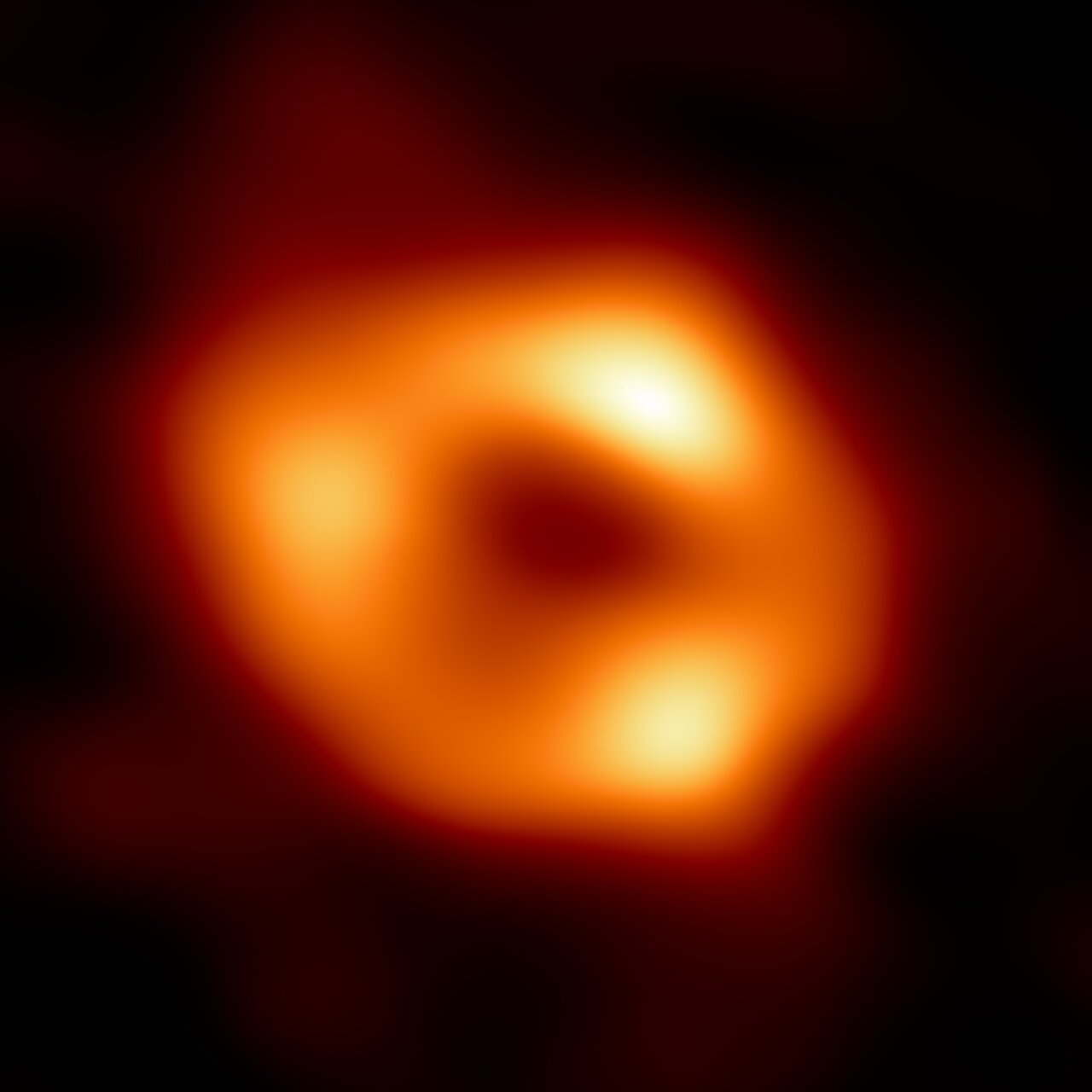
Version 1 · Launch-batch seed: Sagittarius A* EHT image.
What happened
On May 12, 2022, the Event Horizon Telescope (EHT) collaboration released the first image of Sagittarius A* (Sgr A*), the supermassive black hole at the center of the Milky Way, roughly 27,000 light-years from Earth and about four million times the mass of the Sun. The image shows a bright, asymmetric ring of glowing gas surrounding a dark central region — the shadow cast by the black hole's event horizon.
The official ESO release (eso2208) describes years of data processing needed to produce the image, following the same global radio-telescope-network technique the EHT collaboration used for its earlier image of the black hole in the galaxy M87. Sgr A*'s much smaller apparent size and faster internal variability made this particular reconstruction substantially harder.
Why it matters
Sgr A* matters because it is the supermassive black hole in our own galaxy, the one whose gravitational influence on nearby stars had already provided strong indirect evidence of its existence and mass for decades. A direct image tests general relativity's predictions for black hole shadows in an entirely different environment and mass range than M87's much larger black hole.
For learners, the comparison between Sgr A* and M87 is itself instructive: despite Sgr A* being about a thousand times less massive than M87's black hole, both produced remarkably similar shadow sizes relative to their event horizons, matching general relativity's predictions across very different physical scales. That consistency is a meaningful test of the theory, not just a striking picture.
Linking the black-hole and event-horizon concepts here keeps that comparison concrete: an event horizon's size scales with mass in a predictable way, and Sgr A*'s image is a real-world confirmation of that scaling using our own galactic center as the laboratory.
How it was measured
The EHT links radio telescopes across the globe into a single Earth-sized virtual instrument using very long baseline interferometry, achieving the angular resolution needed to resolve a black hole's shadow at galactic-center distances. For Sgr A*, gas orbits the black hole on timescales of minutes to hours, far faster than the days-to-weeks timescale for M87, meaning the source's appearance can change meaningfully during a single night of observing.
To cope with that variability, the collaboration generated thousands of possible images consistent with the data and used statistical and machine-learning techniques to identify common features across them, ultimately averaging toward a representative image rather than a single unprocessed snapshot. That averaging process is central to understanding what the final picture does and does not show.
What scientists thought before
Before this image, decades of tracking individual stars orbiting close to the galactic center — a Nobel Prize-winning body of work — had already established Sgr A*'s mass and location with high precision, providing indirect but very strong evidence for a supermassive black hole there. Radio and X-ray observations had also long identified Sgr A* as a compact, variable source consistent with an accreting black hole.
What was missing before 2022 was a direct image of the shadow itself. The EHT's Sgr A* result did not discover the black hole; it provided the first direct visual confirmation consistent with a mass and behavior already well constrained by other methods.
What remains uncertain
Because the final image is built by averaging over rapid variability, fine-grained details about gas dynamics, magnetic field structure, and moment-to-moment changes near the event horizon are necessarily smoothed out; higher-cadence future observations are needed to capture that faster physics directly.
When you see this now-famous glowing ring, remember it represents a statistical best estimate built to handle a genuinely difficult observational problem, not a single photograph. From here, the black-hole and event-horizon concept pages fill in exactly what that ring is showing and why its size matters.
Key sections
- What happened
- The Event Horizon Telescope produced the first image of Sagittarius A*, showing a ring around the Milky Way's central black hole shadow.
- Why it matters
- It visually confirms horizon-scale gravity for the Galactic Center black hole already weighed by stellar orbits.
- How it was measured
- Global millimeter VLBI reconstructed the ring morphology despite rapid source variability.
- Prior understanding
- Stellar orbits proved a compact massive object at the Galactic Center; horizon-scale imaging awaited EHT sensitivity.
- What remains uncertain
- Time variability complicates imaging; detailed spin and plasma properties remain model-dependent.
Build understanding
- Black hole
A region of spacetime where gravity is so strong that nothing, not even light, can escape from inside the event horizon.
- Event horizon
The boundary around a black hole beyond which light cannot escape to the outside universe.
Related lesson
- What a Black Hole Shadow Means
Separate the event horizon from the larger shadow seen in Event Horizon Telescope images.
Related discoveries
Continue through nearby stories that share instruments, objects, or ideas.
- First Image of a Black Hole: M87*
The Event Horizon Telescope resolves the shadow of a galaxy's central giant.
Two Event Horizon Telescope shadows — Milky Way and M87.
- Webb Finds a Dense Cosmic Knot Around an Extremely Red Quasar
Spectroscopy reveals a forming galaxy cluster core in the early Universe.
Growing black holes nearby and in the early universe.
Sources
Primary sources first. News tips are secondary signals, not the canonical account.
- Astronomers reveal first image of the black hole at the heart of our Galaxy
Primary · official release · ESO / EHT